Smart building for luxury residences
A smart building is not a pile of "smart" gadgets but an engineering approach: lighting, shading, climate, security, AV and energy are designed as one coordinated system — reliable, discreet and upgradeable. In practice, light behaves naturally, shading follows the rhythm of the day, and climate control does not require constant adjustment.
We do not choose technology so it can attract attention, but so it can stop being the topic. In serious buildings, the system has to be mature, serviceable and resistant to surprises.
Integration, not individual gadgets
The difference between a "smart home" and a serious smart building is integration and logic. Instead of a set of independent apps and remotes, all functions work as one system with thoughtful scenes and a clear user experience. We design as an engineering consultant — vendor-neutral, with equipment chosen by the project and the design.
A smart building is not an app. It is the logic of the space.
The user interface is only the final layer of the system. Behind it are lighting, shading, climate, sensors, power supply, network and usage logic. That is why we design a smart home as infrastructure, not as a set of screens.
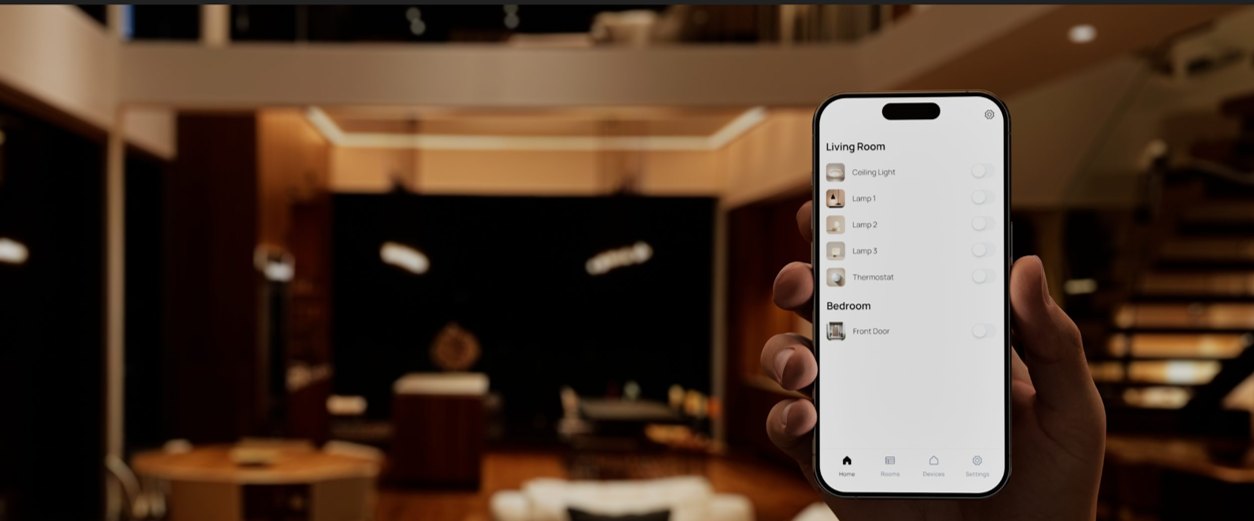
Smart building domains
The standard and the energy layer
KNX — the open standard we build on
KNX is the bus that connects equipment from different manufacturers into a reliable, decentralized system. For us it is a means, not an identity — technology in service of a broader smart building approach.
- Open international standard (ISO/IEC 14543)
- Decentralized — no central point of failure
- Scalable and upgradeable
- Freedom to choose equipment by design
Energy management through the smart building
The smart building is the layer that enables energy: measuring consumption, integrating photovoltaics and batteries, EV charging and HVAC optimization. We design automation and energy together.
- Energy monitoring and sub-metering
- PV and battery storage integration
- Load management and EV charging
- Consumption optimization by scenes
Reliable, discreet, upgradeable
Smart building — questions
Planning a smart building?
Send us a floor plan and concept — we will propose system integration and scenes aligned with the design and your energy goals.